
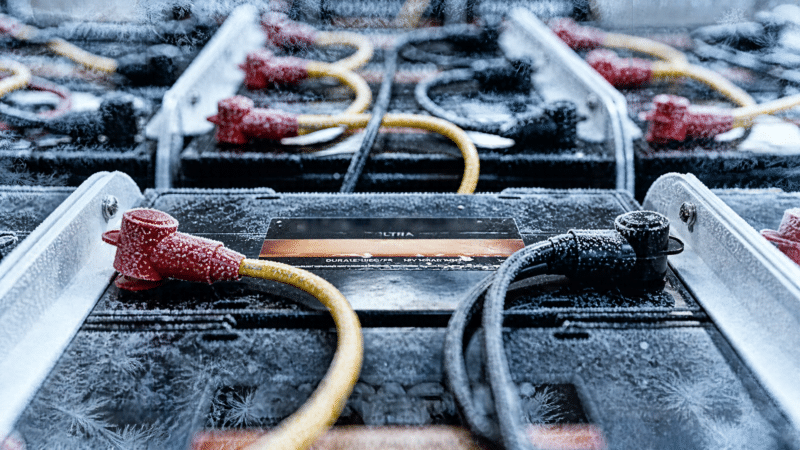
Two lead-acid batteries can sit through the same winter weather and have very different outcomes. One remains ready for service. The other freezes and suffers permanent damage. Often, the difference is how much charge each battery had when the temperature dropped.
The reason is inside the battery. A fully charged lead-acid battery contains an acid-and-water solution that can remain liquid below −60°F. As the battery discharges, that solution becomes more water-rich, raising its freezing point. With sufficiently diluted electrolyte, freezing can begin around 19°F.
For mobile surveillance platforms stored outdoors, maintaining battery charge is essential for winter protection. Understanding the chemistry explains why.
The Protection Starts With The Electrolyte
Lead-acid batteries, including AGM batteries, use the same basic chemistry: a reaction between lead-based plates and an electrolyte made of sulfuric acid and water.
Acid concentration protects against freezing. In a fully charged battery, the electrolyte contains enough sulfuric acid to remain liquid at temperatures far below the freezing point of plain water because it has a higher specific gravity. As the battery discharges, the acid concentration falls, the specific gravity decreases, and the freezing point rises.
Discharging Changes What Is Inside The Battery
As a battery supplies power, sulfuric acid reacts with the material on both plates. Lead sulfate forms on the plates, and water forms in the electrolyte. That reaction produces the electrical energy that runs the platform.
The overall discharge reaction is:
Pb + PbO₂ + 2 H₂SO₄ → 2 PbSO₄ + 2 H₂O
In plain language, lead and lead dioxide react with sulfuric acid to form lead sulfate and water. Here is what each formula represents:
| Formula | Name | Where it lives | What happens during discharge |
|---|---|---|---|
| Pb | Lead | Negative plate | Consumed. Converts to lead sulfate. |
| PbO2 | Lead dioxide | Positive plate | Consumed. Converts to lead sulfate. |
| H2SO4 | Sulfuric acid | Electrolyte | Consumed. Less acid raises the electrolyte's freezing point. |
| PbSO4 | Lead sulfate | Both plates | Produced. Builds up on both plates as the battery discharges. |
| H2O | Water | Electrolyte | Produced. Dilutes the acid toward plain water. |
For winter protection, the change that matters happens in the electrolyte: sulfuric acid is consumed and water is produced, so the deeper the discharge, the closer the electrolyte comes to plain water and the higher its freezing point. Charging reverses the reaction and restores both the acid concentration and the battery’s resistance to freezing. That is why charge matters even when a platform is parked.
At What Temperature Does A Lead-Acid Battery Freeze?
No single freezing temperature applies to every lead-acid battery. It depends on the electrolyte’s acid concentration, which changes with state of charge.
One way to express that concentration is specific gravity, or how dense the electrolyte is compared with water. Water has a specific gravity of 1.00. Within the normal operating range of lead-acid batteries, a higher specific gravity generally means greater resistance to freezing.
As a lead-acid battery loses charge, its electrolyte becomes more vulnerable to freezing. The table below illustrates the general pattern.
| State of Charge | Electrolyte Specific Gravity | Approximate Freezing Point |
|---|---|---|
| Full | 1.265-1.280 | Below -60°F |
| About Half | 1.200 | Around -16°F |
| About a Quarter | 1.150 | Around 5°F |
| Discharged | 1.100 | Around 19°F |
These are general reference points. Actual freezing temperatures depend on electrolyte concentration and battery design.
Why Freezing Can Cause Permanent Damage
When electrolyte freezes, the ice expands. Inside a battery, that expansion can damage plates and separators, loosen active material, and crack the case.
Thawing does not repair that structural damage. A battery may look intact afterward but have reduced capacity, damaged internal connections, or an internal short. It may show voltage but not be able to support the platform’s normal load.
That makes preventing a freeze far more dependable than trying to recover a battery afterward.
Never Charge A Frozen Battery
Do not connect a charger to a battery that is frozen or suspected of being frozen. Charging can create an explosion hazard, and freeze damage can make the battery unsafe.
If freezing is suspected, take the battery bank out of service and follow the battery manufacturer’s recovery guidance.
The next steps are:
- Allow it to thaw completely. Use a suitable, well-ventilated location and allow the battery’s internal temperature to reach room temperature. A large battery bank may take a day or longer. Do not use direct heat to rush the process.
- Inspect each battery. Do not charge or return to service a cracked, bulging, or leaking battery. Arrange proper recycling.
- Follow the approved charging procedure. If the battery is fully thawed, intact, and suitable for a recovery attempt, use the charger and settings specified for that battery.
- Test before returning it to service. Have a qualified technician assess whether it can accept charge, retain charge, and deliver the required capacity.
Cold Weather Changes Performance, Too
A cold battery can deliver less available power even when it has not frozen. Lower temperatures slow its chemical reactions and can make recharging take longer. Use the charging settings and temperature compensation specified for the battery and platform.
Cold also slows self-discharge. A healthy AGM battery that starts storage fully charged and is properly isolated from loads generally loses charge more slowly in cold conditions than in warm conditions.
That does not remove the need for periodic checks. Batteries still self-discharge over time, and any connected equipment can continue drawing power throughout storage.
What This Means For Mobile Pro System Platforms
A parked platform can still consume power. For example, a 24-volt platform in hibernation may wake four times a day to check in through MPStatus. If it remains unplugged, those check-ins continue drawing from the battery bank.
After sufficient discharge, the controller latches out to protect the platform’s electronics. That protects the system but not the batteries: by then the bank is deeply discharged, and a deeply discharged bank is the one that freezes.
The best protection starts before storage: complete the approved charging cycle, follow the platform’s instructions for external power or battery isolation, and check the bank throughout storage.
For the full procedure, read Battery Storage Best Practices for Mobile Pro System Platforms. If you need help preparing your platform for winter or evaluating a battery bank after a suspected freeze, contact the Mobile Pro Systems customer support team.
Frequently Asked Questions
Can a fully charged lead-acid battery freeze?
Yes, at sufficiently low temperatures. However, typical fully charged lead-acid electrolyte freezes well below ordinary winter temperatures, with published reference values below −60°F. Keeping the battery charged greatly reduces the risk of freezing.
At what temperature does a discharged battery freeze?
It depends on the electrolyte concentration and battery design. Electrolyte with a specific gravity of 1.100 can begin freezing around 19°F. A battery does not need to reach 0°F to be at risk.
Can a frozen battery be saved?
Sometimes, but recovery is uncertain. It must thaw completely and be inspected before any approved charging attempt. Visible damage means it should not be charged. An intact case alone does not confirm that the battery is safe or has retained its capacity.
Does cold weather drain a battery?
Cold reduces available performance, but generally slows self-discharge. Connected equipment can still drain the battery during storage, so a parked or hibernating platform may continue losing charge.
Can an AGM battery freeze?
Yes. AGM batteries use sulfuric acid electrolyte, just like flooded lead-acid batteries. Holding that electrolyte in glass mats does not prevent its freezing point from rising as the battery discharges.
Can you check an AGM battery with a hydrometer?
No. AGM batteries are sealed and should not be opened to sample the electrolyte. Use the platform’s charging indicators and the battery manufacturer’s approved electrical testing procedures to assess charge and condition.