Security deployments rarely stay fixed for long. A site that begins with a straightforward need for temporary visual coverage can quickly require more: broader perimeter awareness, thermal visibility at night, automated license plate recognition (ALPR) at access points, stronger analytics, or tighter integration with the workflows your monitoring center, real-time crime center (RTCC), or security operations team already uses.
That is where many buyers run into trouble. A platform that looks cost-effective when the mission is narrow becomes a constraint as conditions change. What starts as a fast surveillance purchase turns into a second procurement. Power workarounds. Another isolated interface. Hard decisions about whether the original deployment can support the technologies the operation now needs.
A mission-adaptable security platform is built to avoid that trap. Instead of solving only the first surveillance problem, it extends coverage now and preserves flexibility for what comes next. At Mobile Pro Systems, that means treating a mobile platform as adaptable security infrastructure: configured for the current mission, matched to the operating environment, and ready to evolve without forcing you into a dead end.
Security requirements change faster than infrastructure projects
One of the most common mistakes in security planning is assuming the first mission will remain the long-term mission. In practice, risks move. Sites expand. Temporary projects run long. A location that needs deterrence and basic video today may need better detection, stronger evidence, or closer coordination with existing command workflows six months from now.
That dynamic is most visible at the edges of the built environment. Parking lots, outparcels, construction sites, utility edges, remote yards, and event perimeters do not stay static long enough for fixed infrastructure to be the only sensible answer. By the time conduit is run, poles are approved, and permanent systems are installed, the operational need has often already shifted.
That does not mean settling for a short-term, narrowly configured deployment. It means asking a better question about the platform you put in the field. Not just whether it deploys quickly — but whether it will still serve the operation six months from now if the mission expands, the sensor mix changes, or you want mobile coverage feeding a broader security ecosystem.
The hidden cost of single-purpose surveillance deployments
Single-purpose deployments look attractive because they look simple. They solve an immediate visibility gap. They are easy to explain internally. In budget conversations, a narrow configuration feels easier to justify than a more capable platform.
The problem shows up later.
If the platform was designed around one sensor type, one power model, or one workflow assumption, every change costs more. Adding technologies forces compromises elsewhere. Integrating with your preferred video management system (VMS) or investigative environment proves harder than expected. A power system sized for basic visual surveillance strains once thermal cameras, analytics, lighting, or additional devices come aboard.
The friction compounds from there. Your team retrains on another interface. Technical staff support another disconnected environment. Investigators pull evidence from a separate workflow. Scaling the original approach means repeating the same integration effort again and again instead of building on a reusable foundation.
That is why the cost of a single-purpose deployment is rarely limited to the hardware decision. The real cost is inflexibility — and it shows up later as re-buying, reconfiguring, retraining, and unnecessary gaps between the mobile platform and the rest of the security operation.
What makes a mission-adaptable security platform different
A mission-adaptable platform is not just a platform with room for add-ons. Adaptability has to be practical at four levels: deployment, power, sensors, and workflow fit.
First, the platform has to support a mission that evolves. A deployment may begin with visual awareness and deterrence, then expand to thermal coverage, ALPR, radar, LiDAR, drone detection, public address, or more advanced analytics. If it cannot support that evolution without major compromise, it is not adaptable.
Second, power architecture matters as much as the sensor stack. Surveillance conversations tend to focus on what mounts on the mast, but long-term field performance depends on how the platform is powered and what conditions it tolerates. Mission adaptability means matching the power model to the site, climate, deployment duration, service burden, and hardware load. A remote site with inconsistent sunlight, long deployment cycles, or heavier power requirements demands a different foundation than a short-term urban deployment with easy service access. It is why Mobile Pro Systems engineers solar and hybrid power configurations rated for 72+ hours of operation without direct sunlight.✱
Third, adaptability includes workflow integration. A mobile platform should not be valuable only inside an isolated operating environment. It should extend the systems you already trust — your VMS, ALPR workflow, monitoring center, or RTCC — and stay observable itself. MPStatus reads device health and power status across deployed platforms in real time, over a million data points per day, flagging issues before they become downtime.✱ The strongest mobile deployments do not feel like adopting a new stack. They feel like extending coverage into places that were previously hard to secure.
That is how Mobile Pro Systems builds. The value is not mobility by itself. It is reliable, field-ready mobility combined with configurable sensor support, practical power options, and an integration approach that preserves the workflows your team already depends on.
Same platform, new mission: what this looks like in the field
The clearest way to understand mission adaptability is to watch the same platform carry different missions over time.
A public-safety hotspot that becomes an intelligence and response problem
A police department first deploys a platform into a retail corridor or parking area because complaints are rising and officers need a visible deterrent. At that stage the need is straightforward: high-crime hotspot deterrence, better visibility, and better documentation when incidents occur.
A few months later, the mission changes. Command staff want mobile video feeding RTCC awareness. Detectives need footage that fits investigative workflows. The department wants to add ALPR or other sensors to understand vehicle movement around the hotspot.
A single-purpose deployment strains at that point. A mission-adaptable platform is already positioned for evolving sensors and tighter workflow integration instead of remaining a detached camera deployment.
A critical infrastructure edge that needs more than visual surveillance
Utilities, substations, pump stations, and remote infrastructure sites often start with a simple requirement: add eyes to a location where fixed infrastructure is slow or expensive to extend. Those environments rarely stay simple. Weather changes. Contractor activity shifts. Temporary staging areas appear. Incident response expectations rise.
What starts as visual monitoring may later require thermal visibility for low-light conditions, more resilient uptime in remote areas, or tighter alignment with a centralized monitoring workflow. In these settings, mobile security for utility sites treats power flexibility as part of the security strategy, not a background technical detail. A platform that performs well only in ideal conditions creates more service burden than it removes.
The right platform gives your team a path to maintain uptime, adjust configurations, and extend broader infrastructure protection into the field without rebuilding the deployment model every time conditions change.
A construction or commercial site where risks do not stay in one place
Construction sites, logistics yards, and commercial outparcels are dynamic by definition. Access points change. Equipment moves. Theft patterns shift. A platform placed for one phase of the project may need a different vantage point — or a different mix of capabilities — later.
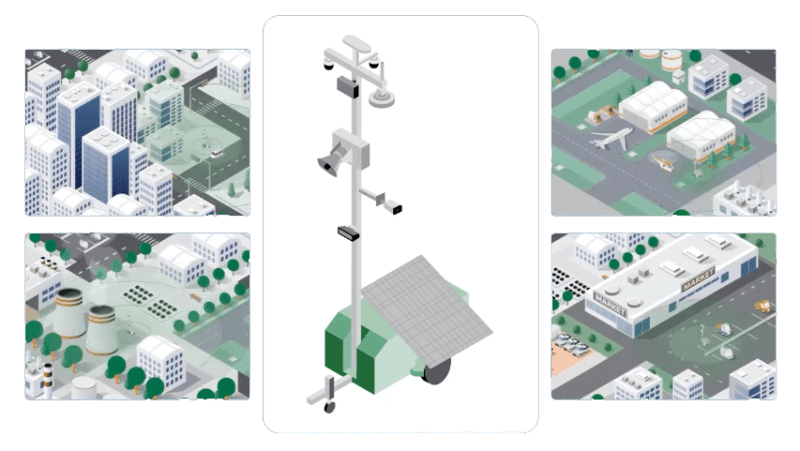
That environment punishes rigid thinking. The same Commander Trailer Platform that anchors proactive construction site security in one phase can carry a different sensor mix in the next, or move to the next project entirely. Instead of a fixed-purpose configuration, you get a reusable security capability that keeps pace with the project itself.
An event perimeter that later demands layered detection
Special events follow the same pattern. An initial deployment focuses on visual coverage, crowd monitoring, and general deterrence around entrances, parking, and pedestrian flows. Depending on the event profile, the requirement expands fast: broader perimeter awareness, thermal visibility, public-address capability, and eventually radar and drone detection for higher-risk environments.
A platform never designed to grow beyond basic surveillance forces a separate buying decision just as the mission becomes more complex. A mission-adaptable approach gives organizers and public-safety partners a platform configured for the event they have now — without foreclosing what the next one may need.
Open and partner-led beats locked-in and narrow
The market increasingly talks in ecosystems, platforms, and connected workflows. You are right to care how a mobile deployment fits with the rest of your environment. But there is a meaningful difference between extending the ecosystem you have and getting pulled into another vendor-controlled one.
Some offerings make the mobile platform the center of gravity. That sounds efficient at first. In practice it often means another login, another monitoring environment, and another set of compromises when you want to connect best-fit technologies. A platform may allow third-party devices in theory while making them harder to monitor, harder to manage, and less reliable in practice.
Mobile Pro Systems stays open and partner-led on purpose. We focus on what the platform has to get right — field reliability, power architecture, deployment flexibility, uptime, and connectivity — and we integrate with the technologies and workflows you already trust rather than pulling you into another parallel stack.
The decision is rarely about features alone. The better question is whether a platform solves the current problem without making the next one harder.
What you should ask before you standardize
Before choosing any mobile security platform, ask a harder set of questions than “how quickly can we deploy this?” Speed matters. Long-term fit matters more.
- Can this platform support additional sensors or capabilities if the mission evolves?
- Is the power architecture right for the environment, climate, and deployment duration we actually face?
- Will this deployment extend our current workflows, or create another separate operating environment?
- If we move this platform to a new mission later, how much of the original investment carries forward?
- Are we buying a short-term fix, or building a reusable security capability?
Those questions reveal the real difference between a single-purpose deployment and a mission-adaptable platform. One solves the first requirement on paper. The other keeps pace with changing risk without starting over each time conditions shift.
A better way to think about mobile security infrastructure
The case for mission adaptability is not that every deployment needs every sensor on day one. It does not. It is that most organizations cannot afford to make mobile security decisions as if the mission will never change.
Mobile Pro Systems builds for that reality. A platform should solve today’s visibility problem without locking you into tomorrow’s constraints. It should carry the right power strategy for the mission, the right sensor mix for the environment, and the right integration approach for the workflows you already rely on.
See how the same platform adapts across missions in the video above, then configure a platform around your mission in the System Builder — or call 952-324-5656 to talk through your site with a deployment specialist.
Evaluating Mobile Surveillance Platforms?
The most expensive surveillance platform is the one you have to replace when the mission changes. Our team can walk you through how agencies and site operators redeploy the same platform across projects, seasons, and sites.