Mobile surveillance trailers are often deployed in locations where grid power is unavailable—construction sites, remote infrastructure, temporary events, and large outdoor facilities. In these environments, reliable surveillance depends entirely on the platform’s off-grid power system.
Hybrid power systems combine a generator, battery storage, and solar panels to maintain continuous operation. The generator provides energy on demand, batteries store and buffer power, and solar reduces generator runtime and fuel consumption. Together, they create a power architecture designed for predictable uptime.
For organizations relying on mobile surveillance, the key question is simple: Will the system still be online when it matters most?
This article explains how hybrid surveillance power systems work, why they are more reliable than solar-only designs, and what to consider when evaluating mobile surveillance trailer power systems.
This article explains how hybrid systems function in practice: how each component contributes to reliability, how control systems manage power automatically, why hybrid architectures fail differently from solar-only systems, and what organizations should consider when evaluating mobile surveillance power systems.
Hybrid Power Systems Explained: Generator, Battery, and Solar
Hybrid power systems—those that combine batteries, solar panels, and a generator—form the backbone of reliable mobile surveillance in the field. This is the architecture seen in serious off-grid applications: telecom, critical infrastructure, and well-designed surveillance platforms. The generator serves as the deterministic power source, ensuring that energy is available when solar production falls short, while solar acts as a helpful extension to reduce generator runtime, stretch fuel, and improve economics—but without being a single point of failure.
Understanding those roles helps explain why hybrid systems behave more predictably under difficult conditions.
Generator: The Controllable Energy Source
The generator is the only component in the system that can reliably produce full power at any time.
Unlike solar panels, which depend on sunlight and good weather, a generator can generate electricity on demand. When it runs, it can support the trailer’s live load and recharge batteries simultaneously.
This makes the generator the system’s deterministic backbone.
When storms reduce solar production, when winter days shorten, or when loads increase, the generator provides the energy needed to maintain operations.
Batteries: The Energy Reservoir
Batteries act as storage, not generation.
Their purpose is to hold energy produced by the generator and solar panels and release it gradually when production drops. In practice, batteries allow trailers to operate quietly overnight, bridge short periods of poor solar conditions, and smooth fluctuations between generator cycles.
In a well-designed hybrid system, batteries are not meant to be drained deeply every night. Instead, they operate within a controlled state-of-charge range that preserves battery life and maintains system stability.
Solar: The Efficiency Engine
Solar panels contribute energy whenever sunlight is available, reducing generator runtime and improving overall efficiency.
Over weeks and months, solar production can significantly reduce fuel consumption, generator operating hours, and service visits.
In hybrid systems, however, solar is not treated as the system’s safety net. Instead, it functions as an efficiency layer: helpful when available but not required for the system to remain operational.
A simple way to think about the relationship is:
- Solar reduces how often the generator must run.
- The generator determines whether the system can stay online under difficult conditions.
How Hybrid Surveillance Trailers Manage Power Automatically
Once the roles of generator, batteries, and solar panels are understood, the next question is how the system behaves in the field.
The answer lies in the control logic.
Modern hybrid systems are designed around a simple priority structure:
- Maintain surveillance coverage
- Protect the power system’s health.
- Minimize fuel consumption
During favorable daylight conditions, solar panels often carry much of the load and help keep batteries within a healthy charge range.
At night or during extended cloud cover, the system continuously monitors battery state of charge and temperature. When battery levels fall below a defined threshold—or when environmental conditions threaten reliable operation—the controller automatically starts the generator.
While running, the generator supports the active system load and simultaneously recharges the batteries. Charging occurs primarily during the efficient “bulk” phase, where most of the energy transfer occurs quickly.
Once batteries recover to a healthy range and charging current tapers off, the controller shuts the generator down again. Solar and stored energy carry the system until the next cycle.
From outside the enclosure, the behavior appears simple: the trailer stays online, and the generator runs only when needed.
Internally, however, the system constantly balances coverage, battery health, and fuel efficiency to ensure none of them compromises uptime.
Solar-Only vs Hybrid Surveillance Trailers: The Energy Margin Problem
One concept explains the difference between solar-only and hybrid power more clearly than almost anything else: energy margin.
Energy margin is the gap between the power a system needs and the power it can produce under difficult conditions.
When that margin is large, the system can absorb storms, seasonal shifts, unexpected loads, and equipment aging without approaching failure.
When the margin is small—or nonexistent—small disruptions compound until the system runs out of energy.
Solar-only systems often operate close to this boundary. During good weather, solar production may exceed daily energy consumption, keeping batteries fully charged. But the system’s margin depends entirely on consistent sunlight.
If several cloudy days occur or winter daylight shortens, solar production may fall below daily consumption. Each day, the batteries recover slightly less energy than they expend, gradually depleting the system’s reserves.
Eventually, the system can no longer replenish its batteries and shuts down.
Hybrid systems address this challenge differently.
Instead of relying entirely on solar production to maintain their energy margin, hybrid systems create a controllable energy supply through the generator. When solar production drops or loads increase, the generator runtime automatically expands to restore balance.
Energy shortages, therefore, do not typically cause outages. They simply cause longer generator cycles.
This shift—from relying on favorable weather to controlling energy supply—is what allows hybrid surveillance systems to behave like dependable infrastructure rather than experimental deployments.
Deployment Autonomy: How Hybrid Systems Behave Differently in the Field
Understanding power architecture is important, but most organizations evaluating mobile surveillance platforms ultimately want to answer a practical question:
How long can the system remain operational without intervention?
This concept is often referred to as deployment autonomy—the amount of time a trailer can remain in the field while maintaining full functionality without requiring service, refueling, or repositioning.
Autonomy depends on several interacting factors:
- the system’s power budget
- battery storage capacity
- Solar production in the local climate
- generator capacity and fuel storage (for hybrid systems)
- and the operational expectations placed on the trailer.
Because these variables interact, two trailers with similar specifications on paper may behave very differently in the field.
Solar-Only Autonomy
Solar-only systems often advertise long autonomy figures under ideal conditions. During periods of strong sunlight and modest system loads, solar panels can replenish the energy consumed each day, keeping batteries near full charge.
However, this autonomy depends on consistent solar recovery. When production falls below daily consumption for several days—due to weather, seasonal changes in daylight, or shading—the system gradually depletes its energy reserves.
At that point, autonomy is limited by the battery bank. Once the stored energy is exhausted, the system shuts down until solar production returns or the unit is serviced with an emergency service visit.
Hybrid Autonomy
Hybrid systems approach autonomy differently.
Instead of depending solely on solar recovery, they use the generator as a controllable energy source. When batteries approach a defined threshold, the generator starts automatically, supports the live system load, and restores battery reserves.
Because fuel effectively serves as an additional energy reservoir, hybrid systems can maintain autonomy for far longer than solar-only designs.
In practice, the autonomy of a hybrid trailer is primarily determined by fuel capacity and service schedules rather than by weather patterns.
Autonomy as an Operational Planning Tool
For organizations deploying mobile surveillance, autonomy is not just a technical metric—it is a planning tool.
Longer autonomy means:
- fewer service visits
- reduced risk of unexpected outages
- greater flexibility when deploying
trailers in remote or hard-to-access locations.
When evaluating surveillance platforms, it is useful to ask not only how the system generates power, but also how long it can maintain full operation under realistic conditions.
Why Hybrid Power Systems Are More Reliable for Long Deployments
When you step back from the details, the reason hybrid architectures matter becomes straightforward.
Mobile surveillance exists to extend your view to places that are hard to cover with fixed infrastructure: temporary events, remote lots, rail corridors, construction sites, trouble spots in a city, and the edges of large campuses. Those are exactly the places where grid power is inconsistent, unavailable, or expensive to bring in.
In those locations, you are asking a trailer to do something simple but demanding: stay online, record, and communicate through whatever the weather and workload bring. Cameras, analytics, networking, and integration all matter—but none of them can do their job if the power system quietly runs out of margin.
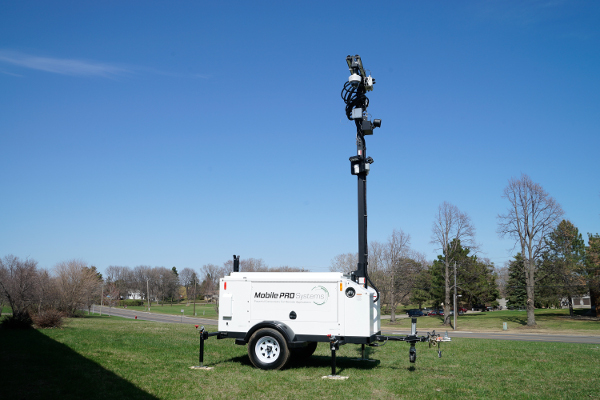
A hybrid design like in the Commander 3400 that treats the generator as a deliberate energy source, uses batteries as a buffer rather than a crutch, and lets solar pull its own weight without being the hero changes that equation. Outages become rare exceptions instead of seasonal rituals. Site visits are planned maintenance, not emergency recoveries. Operations teams can treat trailers as reliable extensions of their security infrastructure rather than as experiments.
Most importantly, trust increases. When an incident occurs, the question is no longer “Did the trailer stay awake?” but “What does the footage show, and how quickly can we act on it?” That shift—from worrying about whether the trailer is still online to assuming that it is—is the real value of hybrid power.
Hybrid power does not eliminate the need for good planning. It does give you a power architecture that behaves like the rest of your critical infrastructure: designed for hard days, not just impressive numbers in perfect conditions.
Talk to Our Team About Reliable Off-Grid Surveillance
If you’re evaluating mobile surveillance trailers for remote, temporary, or long-duration deployments, our team can help you compare power architectures, deployment requirements, and operational tradeoffs. Speak with Mobile Pro Systems sales to see how the Commander 3400 supports dependable uptime in the field.
Frequently Asked Questions About Hybrid Power for Mobile Surveillance Trailers
Leaders evaluating mobile surveillance power systems often ask similar questions about generators, maintenance, and reliability. The answers below clarify how hybrid power systems behave in real-world deployments.
Do hybrid surveillance trailers run generators all the time?
No. In a properly designed hybrid system, the generator runs only when necessary. Solar panels and batteries handle much of the daily operation, especially during favorable weather.
When the generator does run, it typically operates in short cycles to recharge batteries efficiently before shutting down again. The goal is to keep the system online while minimizing generator runtime and fuel consumption.
Are hybrid mobile surveillance trailers harder to maintain?
Hybrid systems include generators, which require periodic service such as oil and filter changes. However, because generators in hybrid systems run intermittently rather than continuously, maintenance intervals are often longer than people expect.
More importantly, hybrid systems tend to reduce emergency service visits. Instead of responding to trailers that unexpectedly lose power, maintenance can usually be scheduled during routine fleet service.
Are solar-only surveillance trailers more reliable because they are simpler?
Solar-only systems eliminate mechanical components but also eliminate the ability to generate energy when sunlight is insufficient.
When several cloudy days occur or winter daylight shortens, solar production can fall below the system’s energy demand. Over time, batteries may not fully recharge, eventually leading to outages.
Hybrid systems address this by adding a controllable energy source. When solar production drops, the generator automatically produces the energy needed to maintain operations.
Are hybrid surveillance trailers less environmentally friendly than solar-only systems?
Hybrid systems still rely heavily on solar energy. Solar panels often account for a significant portion of daily energy demand, reducing generator runtime and lowering fuel consumption compared with generator-only systems.
The difference is that hybrid systems include a generator to maintain uptime when solar production drops, ensuring the surveillance platform remains operational even during extended storms or low-sun seasons.
Are hybrid surveillance trailers more complicated to manage?
Mobile Pro Systems hybrid trailers include remote monitoring with MPStatus that report generator runtime, battery state of charge, and solar production.
This telemetry enables operations teams to monitor system health across deployments, identify issues such as shading or rising loads, and plan services before outages occur. In practice, the visibility provided by MPStatus makes fleets easier to manage.
What is the biggest difference between solar-only and hybrid surveillance power systems?
Solar-only systems rely entirely on environmental conditions to maintain their energy supply. If solar production falls short for several days, the system may eventually run out of power.
Hybrid systems add a controllable energy source. When solar production drops, the generator runs to maintain the system’s energy margin and keep the trailer online.
This ability to generate power on demand enables hybrid systems to maintain uptime even under difficult conditions.